Queer Places:
Cypress Grove Cemetery, 120 City Park Ave, New Orleans, LA 70124, United States
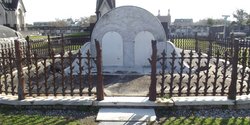 Louise Jonas “Mother” Nixon (August 15, 1856 – June 16, 1947) was a prominent cultural fixture in early 20th-century New Orleans, best remembered as a foundational force
behind the city's legendary community theater movement and a central matrix point for the bohemian, literary, and queer circles of the French Quarter.
Louise Jonas “Mother” Nixon (August 15, 1856 – June 16, 1947) was a prominent cultural fixture in early 20th-century New Orleans, best remembered as a foundational force
behind the city's legendary community theater movement and a central matrix point for the bohemian, literary, and queer circles of the French Quarter.
Born Louise Jonas in August 1856, she belonged to an established, well-connected local family with deep roots in Louisiana. She married James Oscar Nixon II, embedding
herself further into the social and civic networks of New Orleans. By the time she was widowed, she commanded significant social capital, using her status, charm, and
organizational drive to shape the city's cultural landscape.
In 1916, amidst a burgeoning revival of arts in the French Quarter, Nixon joined with other local culture patrons (including
Helen Pitkin Schertz.html">Helen Pitkin Schertz) to establish Le Petit Théâtre du Vieux Carré. What began as intimate amateur productions in private
drawing rooms grew into one of the nation's most celebrated community playhouses. Nixon's leadership solidified her as the matriarch of the institution; she was
affectionately dubbed "Mother" Nixon and served as the theater's president-for-life until her death.
Beyond theater, Nixon was deeply integrated into the glittering, non-conformist literary community that flourished in New Orleans during the 1920s. She rubbed shoulders
with luminaries such as William Faulkner, Sherwood Anderson,
Lyle Saxon, Natalie Scott, and
William Spratling. Her home and social circle bridged the gap between old-line New Orleans society and the radical,
avant-garde artists and writers who gravitated toward the French Quarter.
Nixon remained an active and formidable presence in New Orleans arts well into her later decades. She passed away in June 1947 at the age of ninety in Pass Christian,
Mississippi, leaving behind a legacy as one of the chief architects of New Orleans' modern cultural identity.
While Louise Jonas Nixon was a traditional society widow by background, her historical significance is profoundly intertwined with early 20th-century queer history
through the social ecosystem she fostered and protected:
The artistic bohemian community of 1920s and 1930s New Orleans—centered around Le Petit Theatre, the Arts and Crafts Club, and local literary salons—acted as a vital
haven for gay, lesbian, and gender-nonconforming artists, writers, and photographers seeking refuge from rigid American moralities. As the permanent head of Le Petit
Theatre, Nixon presided over an institution that heavily employed and served as a sanctuary for prominent queer creatives.
Nixon is historically documented alongside the famous network immortalized by William Spratling and Sherwood Anderson in Sherwood Anderson and Other Famous Creoles
(1926)—a satirical yet affectionate portrait gallery of the French Quarter's bohemian elite. This tight-knit circle included numerous foundational queer figures,
expatriates, and modernists (such as photographer William “Cicero” Odiorne and designer/artist
Louis Andrews Fischer).
Though operating from a position of respectable upper-class widowhood ("Mother" Nixon), her alliance with avant-garde artists, cross-dressers, gay literati, and bohemian
rebels demonstrated a radical tolerance and active support for counter-cultural expressions that defied the heteronormative expectations of the Jim Crow-era South.
In 1926 Pelican Bookshop Press, New Orleans, published "William Spratling and William Faulkner, Sherwood Anderson and Other Famous Creoles: A Gallery of Contemporary New Orleans",
issued in 250 copies. The “Famous Creoles” (with ages in 1926) were
- Conrad Albrizio, 27, New York-born, serious artist, Spratling’s neighbor, Arts and Crafts Club stalwart
- Sherwood Anderson, 50, “Lion of the Latin Quarter,” eminence gris, generous to respectful younger writers (LGBTQ friendly)
- Marc Antony and Lucille Godchaux Antony, both 28, Love-match between heiress and lower-middle-class boy, local artists
- Hamilton “Ham” Basso, 22, Star-struck recent Tulane grad, aspiring writer, good dancer (LGBTQ friendly)
- Charles “Uncle Charlie” Bein, 35, Director of Arts and Crafts Club’s art school; lived with mother, sister, and aunt (GAY)
- Frans Blom, 33, Danish archeologist of Maya, Tulane professor, colorful resident of Quarter
- Roark Bradford, 30, Newspaperman, jokester, hit pay dirt with Negro dialect stories
- Nathaniel Cortlandt Curtis, 45, Tulane architecture professor, preservationist, recorded old buildings
- Albert Bledsoe Dinwiddie, 55, President of Tulane, Presbyterian
- Marian Draper, 20, Ziegfeld Follies alum, Tulane cheerleader, prize-winning architecture student
- Caroline “Carrie” Wogan Durieux, 30, Genuine Creole, talented artist living in Cuba and Mexico, painted by Rivera
- William “Bill” Faulkner, 29, Needs no introduction, but wrote the one to Famous Creoles (LGBTQ friendly)
- Flo Field, 50, French Quarter guide, ex-journalist, sometime playwright, single mother
- Louis Andrews Fischer, 25, Gender-bending Mardi Gras designer, named for her father (LGBTQ friendly)
- Meigs O. Frost, 44, Reporter’s reporter; lived in Quarter; covered crime, revolutions, and arts
- Samuel Louis “Sam” Gilmore, 27, Greenery-yallery poet and playwright, from prominent family (GAY)
- Moise Goldstein, 44, Versatile and successful architect, preservationist, active in Arts and Crafts Club
- Weeks Hall, 32, Master of and slave to Shadows-on-the-Teche plantation, painter, deeply strange (GAY)
- Ronald Hargrave, 44, Painter from Illinois formerly active in Quarter art scene, relocated to Majorca
- R. Emmet Kennedy, 49, Working-class Irish boy, collected and performed Negro songs and stories
- Grace King, 74, Grande dame of local color literature and no-fault history, salonnière
- Alberta Kinsey, 51, Quaker spinster, Quarter pioneer, indefatigable painter of courtyards
- Richard Ray Kirk, 49, Tulane English professor and poet, loyal Michigan Wolverine alumnus
- Oliver La Farge, 25, New England Brahmin, Tulane anthropologist and fiction-writer, liked a party
- Harold Levy, 32, Musician who ran family’s box factory, knew everybody, turned up everywhere
- Lillian Friend Marcus, 35, Young widow from wealthy family, angel and manager of Double Dealer (LGBTQ friendly)
- John “Jack” McClure, 33, Poet, newspaper columnist and reviewer, Double Dealer editor, bookshop owner
- Virginia Parker Nagle, 29, Promising artist, governor’s niece, Arts and Crafts Club teacher
- Louise Jonas “Mother” Nixon, 70, A founder of Le Petit Theatre and its president-for-life, well-connected widow
- William C. “Cicero” Odiorne, 45, Louche photographer, Famous Creoles’ Paris contact (GAY)
- Frederick “Freddie” Oechsner, 24, Recent Tulane graduate, ambitious cub reporter, amateur actor
- Genevieve “Jenny” Pitot, 25, Old-family Creole, classical pianist living in New York, party girl
- Lyle Saxon, 35, Journalist, raconteur, bon vivant, host, preservationist, bachelor (GAY)
- Helen Pitkin Schertz, 56, Clubwoman, civic activist, French Quarter guide, writer, harpist
- Natalie Scott, 36, Journalist, equestrian, real-estate investor, Junior Leaguer, social organizer (LGBTQ friendly)
- William “Bill” Spratling, 25, Famous Creoles illustrator, Tulane teacher, lynchpin of Quarter social life (GAY)
- Keith Temple, 27, Australian editorial cartoonist, artist, sometimes pretended to be a bishop
- Fanny Craig Ventadour, 29, Painter, Arts and Crafts Club regular, lately married and living in France
- Elizebeth Werlein, 39, Suffragette with colorful past, crusading preservationist, businessman’s widow
- Joseph Woodson “Pops” Whitesell, 50, Photographic jack-of-all-trades, French Quarter eccentric, inventor (GAY)
- Daniel “Dan” Whitney, 32, Arts and Crafts Club teacher, married (two) students, beauty pageant judge
- Ellsworth Woodward, 65, Artistic elder statesman, old-fashioned founder of Newcomb art department
References:
Other references:
- Historical records, local archives, and institutional histories detailing the founding and early decades of Le Petit Théâtre du Vieux Carré in New Orleans (1916 onwards).
- Biographical documentation and genealogical registers concerning prominent old-line Louisiana families, including the Jonas and Nixon families.
- Literary histories and memoirs chronicling the 1920s French Quarter bohemian and modernist literary movement in New Orleans (such as accounts involving Lyle Saxon, Sherwood Anderson, and William Spratling).
- Social history frameworks examining the underground and protected havens provided for early 20th-century queer artists, writers, and expatriates within New Orleans cultural institutions.
Support this project
This website is a passion project researched, developed, and funded entirely by me. If you find the content valuable and would like to help support the ongoing research and hosting costs, any contribution is deeply appreciated.
Thank you for keeping this independent resource alive!
My books on Amazon: Elisa Rolle's books
BACK TO HOME PAGE
